
Find Glastonbury Deed Records
Land records in Glastonbury are kept by the Town Clerk, not at the county level. If you need to find a deed, mortgage, or any other document related to real estate in Glastonbury, you must go through the local town office. Connecticut law requires all property transactions to be recorded where the land sits. This means Glastonbury deeds stay in Glastonbury. You can search these records online or visit the Town Clerk at 2155 Main Street. The office handles everything from warranty deeds to liens, maps, and subdivision plans. Online access is available through state portals that let you view indexed information any time of day or night.
Glastonbury Town Clerk Office
The Town Clerk in Glastonbury manages all deed records for properties located within the town. This office is part of Hartford County but operates independently when it comes to land records. You will not find Glastonbury deeds at any county office because Connecticut does not use county recording. Each town maintains its own system. The Glastonbury Town Clerk office sits at 2155 Main Street. Staff can help you understand what documents are available and how to access them. You can also use e-recording services to file documents without visiting in person.
Office hours run Monday through Friday from standard business hours. If you plan to record a document in person, bring it before closing time. The office stops accepting land record filings about 15 minutes before closing. E-recording is accepted throughout the day via approved vendors like Simplifile and CSC. These systems let you submit deeds and other documents electronically. The town clerk will process them and return recorded copies. All recordings must meet state requirements for formatting, signatures, and notarization.
Address: 2155 Main Street, Glastonbury, CT 06033
Phone: (860) 652-7610
Hours: Monday - Friday, 8:30 AM - 4:30 PM
How to Search Land Records
Glastonbury participates in the Connecticut Town Clerks Portal. This system gives you 24/7 access to indexed land records and images. You can search by name, book, page, or document type. The portal is free to search, but printing or saving images may require a subscription. Many people use this tool to research property history before buying a home or settling an estate. The index goes back decades, and document images are available for more recent filings.
You can also use US Land Records to search multiple towns at once. Select Glastonbury from the town list. This site works the same way as the state portal. It shows you who owns what, when transfers happened, and what mortgages are on file. If you need certified copies of a document, you must contact the Town Clerk directly. Online searches let you view records, but official copies come from the town office with a certification stamp and fee.
Glastonbury Quick Facts
Recording Fees and Requirements
As of July 1, 2025, Glastonbury charges $70 to record the first page of any document and $5 for each page after that. These fees are set by state law under Connecticut General Statutes Section 7-34a. If your deed involves a nominee like MERS, the first page costs $160 instead. The state also adds a $2 fee for any conveyance with consideration over $2,000. This money funds the conveyance tax system managed by the Department of Revenue Services.
Your document must be in black ink on white paper, either 8.5" x 11" or 8.5" x 14". Use at least 10-point font. The grantor must sign the deed, and you must print their name beneath the signature. If you forget to print names, the town adds a $1 fee. The grantee's current mailing address must appear on the deed. Missing this costs you another $5. All deeds need notarization and two witnesses. The notary can count as one witness. These rules come from CGS Title 47, which governs land records across Connecticut.
Conveyance Tax in Glastonbury
When you transfer property in Glastonbury, you pay both state and local conveyance taxes. The state rate is 0.75% on the first $800,000 of a residential sale and 1.25% on amounts above that. Non-residential property is taxed at 1.25% on the full amount. Glastonbury adds its own local tax, which is typically 0.25%. You file these taxes using Form OP-236, the Connecticut Real Estate Conveyance Tax Return.
Form OP-236 must be submitted electronically through the Department of Revenue Services portal. The town clerk forwards a copy to the state within 10 days of recording. If your transaction involves more than two grantors, you also need Schedule A. Multiple grantees or an entity grantee requires Schedule B. Exemptions exist for transfers between family members, certain trusts, and foreclosure deeds. Read the form instructions carefully or consult an attorney if you are unsure whether your transfer is taxable.
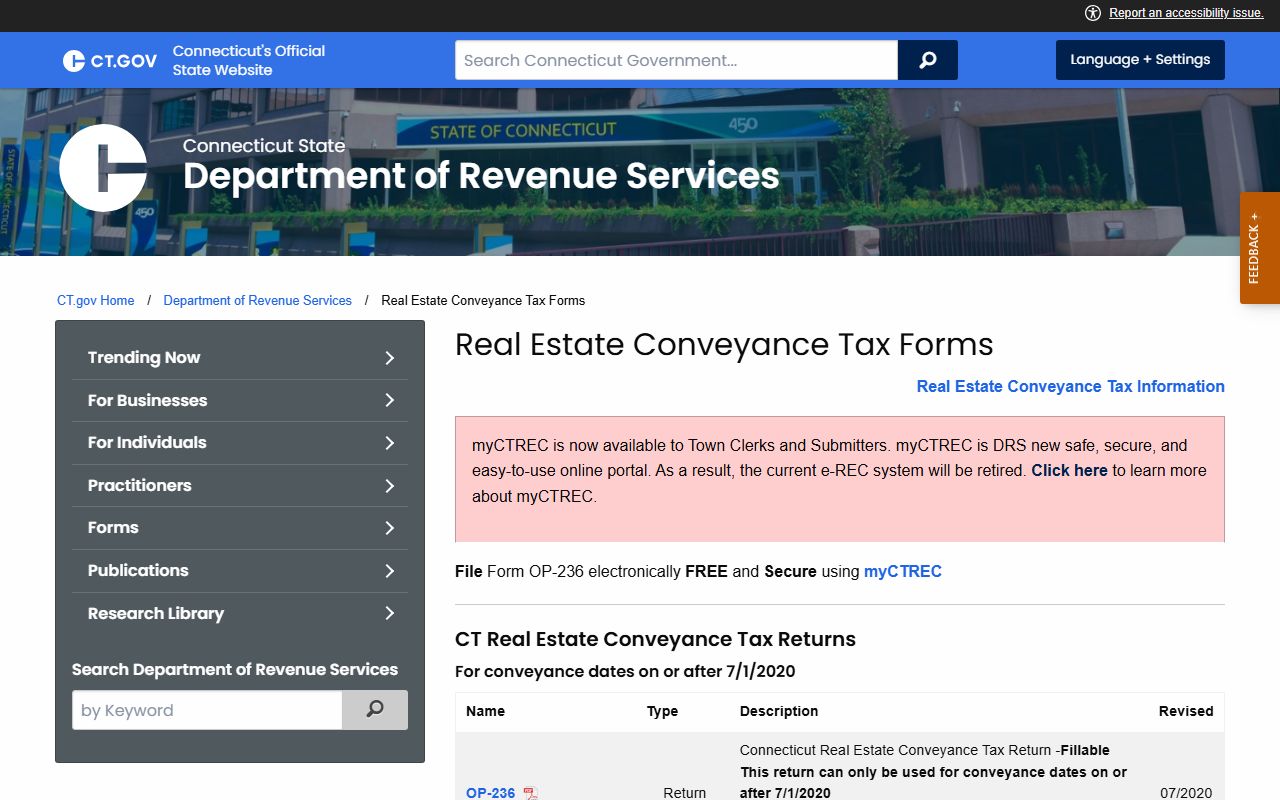
The Connecticut Department of Revenue Services provides all the forms you need for conveyance tax filings. This includes Form OP-236 and its schedules. The image above shows the forms page where you can download current versions. These forms change occasionally, so always use the latest edition when recording a deed in Glastonbury.
Online Access and Subscription
Glastonbury land records are available online through the Connecticut Town Clerks Portal and US Land Records. Both systems let you search for free. You can look up names, see when documents were recorded, and view basic information about each filing. If you want to print or save document images, you need a subscription. The portal offers monthly and annual plans. Prices vary, but most towns charge around $30 for a month of access or $100 to $130 for a year.
Subscriptions are useful for title researchers, real estate professionals, and attorneys who need frequent access. Casual users may prefer to pay for individual documents through the town clerk. Copies cost $1 per page. Certification adds $2 per document. You can order copies by phone, mail, or in person. Some people use the online search to identify the exact book and page, then request a certified copy from the clerk. This method saves time and money compared to subscribing for one-time research.
E-Recording Services
Glastonbury accepts electronic recordings through four approved vendors. Simplifile is one of the most popular. You create an account, upload your document, pay the fee online, and the system submits it to the town clerk. The clerk reviews it and either accepts or rejects the filing. If accepted, you get a recorded copy with the official stamp and book-page reference. If rejected, you receive an explanation of what needs to be fixed.

The image above shows Simplifile, one of the e-recording vendors approved by Connecticut towns. E-recording saves time and lets you submit documents from anywhere. Other vendors include CSC, ePN, and Indecomm. Each works similarly. You pay the recording fee plus a small vendor fee. The total cost is often less than driving to the town clerk and paying for parking.
E-recording works for most land documents, including deeds, mortgages, releases, and assignments. However, some transactions that require Form OP-236 cannot be submitted electronically. Check with your vendor or the town clerk before attempting to e-record a conveyance. Maps and subdivision plans may also need to be filed in person. The town clerk can tell you which documents are eligible for e-recording and which must be submitted on paper.
Types of Documents Recorded
The Glastonbury Town Clerk records all documents that affect land title. This includes warranty deeds, quitclaim deeds, and fiduciary deeds. Mortgages are recorded when you buy a home with a loan. When you pay off the loan, a release or discharge of mortgage is recorded. Liens from contractors, tax authorities, or judgment creditors also go on record. These liens attach to the property and must be cleared before you can sell.
Other documents include easements, which grant rights to use land for specific purposes like driveways or utilities. Affidavits of title, name affidavits, and survivorship affidavits are recorded to clarify ownership. Condominium documents, including master deeds and bylaws, are filed when a new condo development is created. Maps and subdivision plans show how land is divided into lots. All of these records are public. Anyone can search them and obtain copies.
Marketable Title in Connecticut
Connecticut follows the Marketable Record Title Act, which is part of CGS Title 47. This law says you have marketable title if you can show an unbroken chain of ownership going back 40 years. The root of title must be a document recorded at least 40 years ago. Anything that happened before the root of title is extinguished unless it was re-recorded or falls under an exception.
This rule simplifies title searches. Instead of going back 100 years or more, you only need to check 40 years of records. Glastonbury land records go back much further than that, but for most transactions, a 40-year search is enough. Title companies and attorneys use this law to determine if a property has clear title. If there are old claims or defects that were not re-recorded, they do not affect current ownership. However, certain interests like easements and mineral rights may survive even if they are older than 40 years.
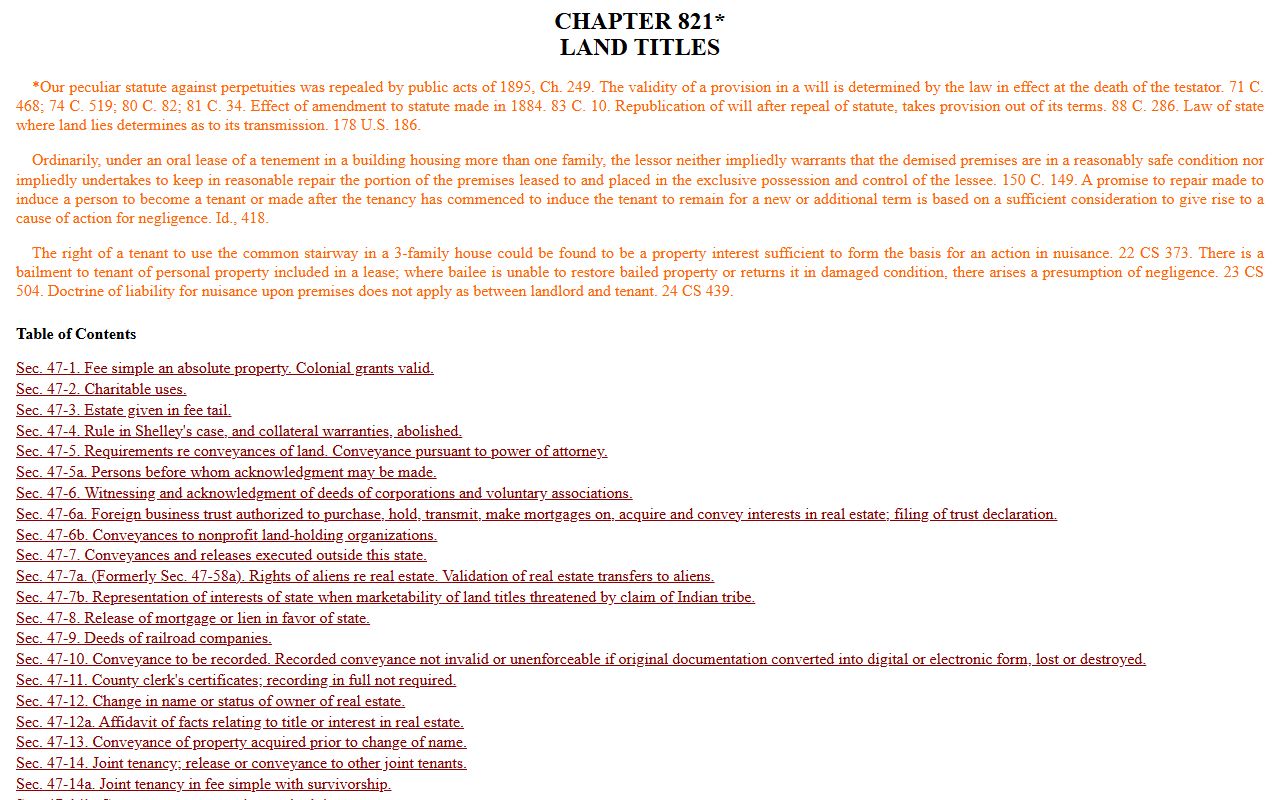
The image above displays Connecticut General Statutes Chapter 821, which covers land and land titles. Section 47-10 requires all conveyances to be recorded in the town where the land is located. Section 47-33b through 47-33l cover the Marketable Record Title Act. These statutes apply to Glastonbury and every other town in Connecticut. They ensure that land records are organized, accessible, and legally enforceable.
Legal Resources in Glastonbury
If you need legal advice about deed records, consult an attorney. The town clerk cannot give legal advice or tell you which type of deed to use. An attorney can prepare deeds, review title, and handle complex transactions. The Connecticut Secretary of the State maintains a list of notaries and business services, but does not provide legal referrals. The Connecticut Bar Association may be able to help you find a real estate attorney in the Glastonbury area.
Legal aid organizations serve low-income residents who cannot afford private attorneys. Statewide Legal Services of Connecticut offers help with housing issues, which sometimes involve deed questions. Their services are free for those who qualify. You can find contact information on the Connecticut Judicial Branch website. The judicial branch also provides self-help resources and court forms for people representing themselves in legal matters.
Nearby Cities with Deed Records
Glastonbury is surrounded by other Hartford County towns that maintain their own land records. Manchester is just north of Glastonbury and uses SearchIQS for online access. Hartford, the county seat, has extensive land records dating back to colonial times. Newington and Wethersfield are also nearby. Each town has its own clerk, its own online system, and its own office hours. If you own property in multiple towns, you must search each town separately.
East Hartford is across the Connecticut River and uses a different online platform. South Windsor and Windsor also maintain independent systems. When researching property in the Glastonbury area, make sure you know which town the land is in. Addresses can be misleading, especially near town borders. Check the property assessment records or ask the seller to confirm the town name. Recording a deed in the wrong town is a costly mistake that can delay closing and create title problems.
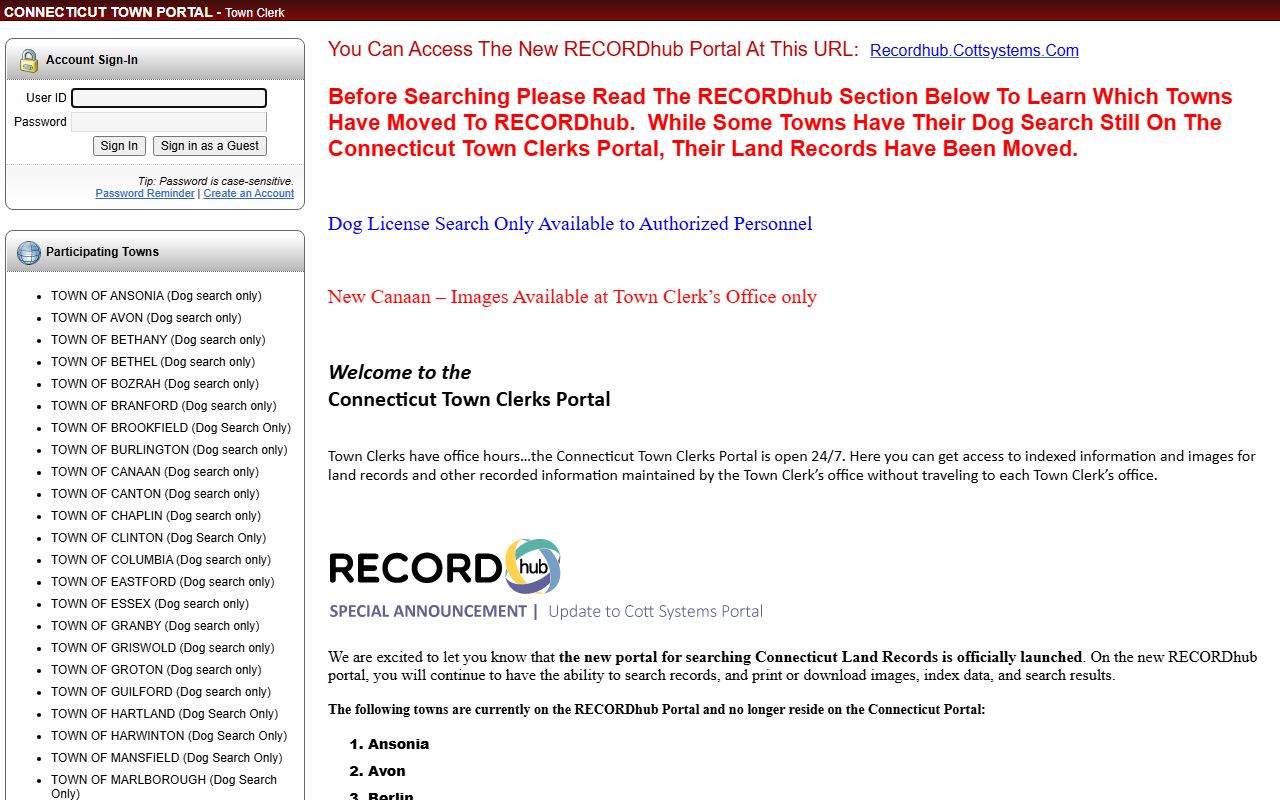
The Connecticut Town Clerks Portal serves over 70 cities and towns, including Glastonbury. This portal gives you access to land record indexes and images around the clock. You can search from home, from work, or from anywhere with an internet connection. The image above shows the portal homepage, where you select the town you want to search. Each town's records are separate, but the search interface is the same across the state.