
Search Hartford Deed Records
Hartford deed records are maintained by the Town and City Clerk at 550 Main Street. As Connecticut's capital and the seat of Hartford County, the city keeps extensive land records dating back to colonial times. Connecticut does not use county recording. All deeds, mortgages, liens, and maps for Hartford property are filed only in Hartford, not at county offices. You can search these records online through SearchIQS or visit the clerk in person. The office handles warranty deeds, quitclaim deeds, mortgage releases, easements, and subdivision plans. Online access is available 24 hours a day. Certified copies must be ordered from the town clerk for official use.
Hartford Town and City Clerk Office
The Hartford Town and City Clerk manages all deed recordings for properties located in Hartford. This office operates independently for land records. There is no county recorder in Connecticut. Each of the state's 169 towns keeps its own land records. The Hartford Town and City Clerk is located at 550 Main Street in the heart of downtown. Staff can help you search for documents, explain recording procedures, and answer questions about fees. You can also use electronic recording services to submit documents without visiting the office.
Office hours run Monday through Friday during standard business hours. If you plan to record a document in person, bring it before closing time. Most town clerks stop accepting land records about 15 minutes before the office closes. E-recording is available all day through approved vendors like Simplifile, CSC, and ePN. These systems let you upload your deed or mortgage, pay the fee online, and receive a recorded copy by email. The clerk reviews each submission and either records it or rejects it with an explanation.
Address: 550 Main Street, Hartford, CT 06103
Phone: (860) 757-9750
Website: hartfordct.gov/Government/Town-and-City-Clerk
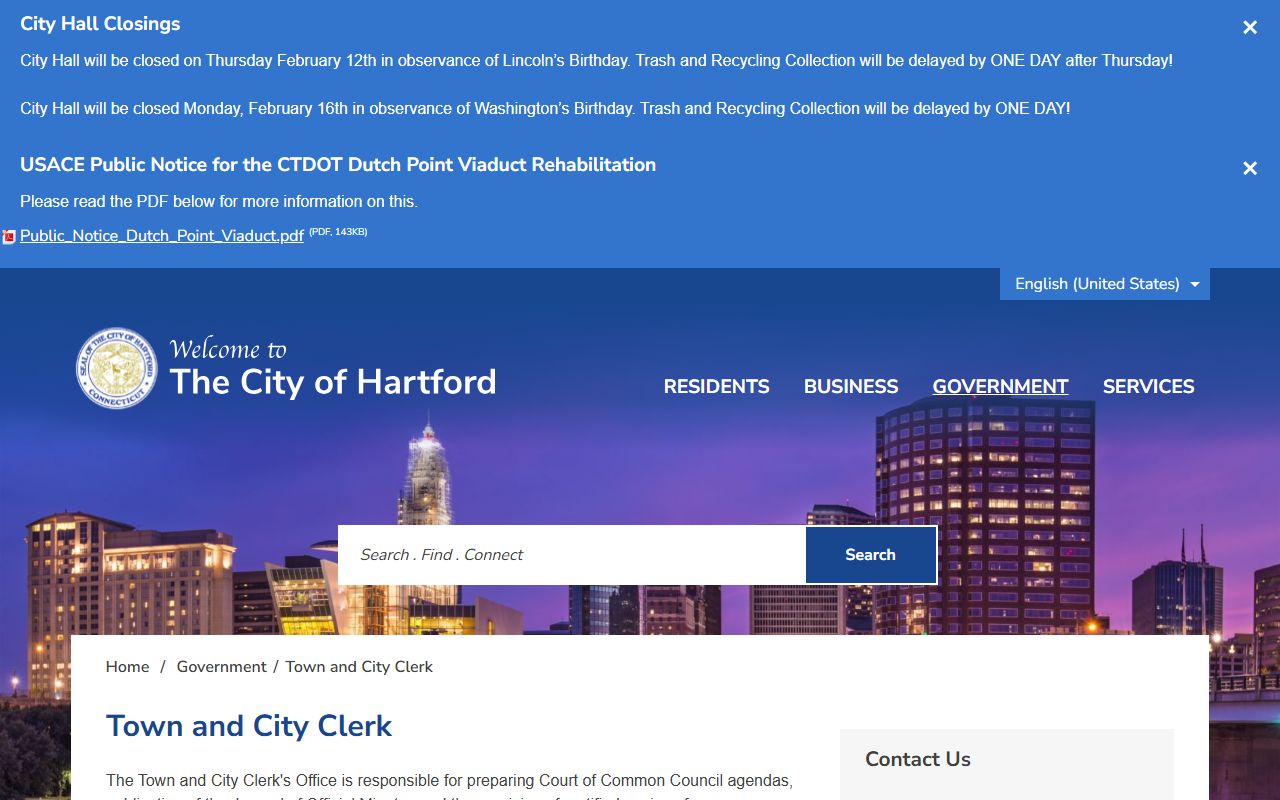
The Hartford Town and City Clerk website provides access to land records and other municipal services. The image above shows the clerk's webpage, where you can find links to online record search tools. Hartford uses SearchIQS for online access to land records. This system is available around the clock and lets you view indexed information and document images.
Searching Hartford Land Records
Hartford land records can be searched online through SearchIQS. This system is free to search. You can look up names, addresses, book and page numbers, and document types. The portal displays indexed information and lets you view images of recorded documents. If you want to print or save images, you may need to purchase a subscription. Subscriptions vary in price, but most towns charge around $30 for one month or $100 to $130 for a full year.
You can also use the Connecticut Town Clerks Portal to search Hartford records. This statewide system covers more than 70 towns. Select Hartford from the list, then enter your search terms. Results appear within seconds. For certified copies, contact the Town and City Clerk directly. Online searches are for informational purposes. Official copies come from the clerk with a certification stamp and require payment of copy and certification fees.
Hartford Land Record History
Hartford's land records date back to the 1600s, making them some of the oldest in Connecticut. These records document the city's growth from a colonial settlement to the state capital. Early records are handwritten and can be difficult to read. Later records are typewritten or printed. Modern records are digital and easier to search. The town clerk maintains all of these records, from the oldest deeds to the most recent mortgage releases.
Researchers, historians, and genealogists often use Hartford land records to trace property ownership and family history. The records show who owned what land, when it was sold, and for how much. They also reveal details about mortgages, liens, and other encumbrances. If you are researching Hartford property history, start with the online search tools. For records older than what is available online, visit the clerk's office in person. Staff can help you locate records in the archives.
Hartford Quick Facts
Recording Fees in Hartford
As of July 1, 2025, the recording fee in Hartford is $70 for the first page and $5 for each additional page. These fees are set by state law under Connecticut General Statutes Section 7-34a. If your document involves a nominee like MERS, the first page costs $160. The state adds a $2 fee for conveyances with consideration over $2,000. This surcharge funds the conveyance tax reporting system managed by the Department of Revenue Services.
Additional fees apply if your document is missing required information. If the grantee's current mailing address is not on the deed, the clerk adds $5. If names are not printed beneath signatures, you pay an extra $1. Copies of documents cost $1 per page. Certification adds $2 per document. Maps cost $20 to file, or $30 if the map shows a subdivision with three or more parcels. These fees are the same across Connecticut. Every town follows the state fee schedule.
Document Requirements
All deeds recorded in Hartford must meet state formatting requirements. The document must be on white paper, either 8.5" x 11" or 8.5" x 14". Use black ink and a font size of at least 10 points. The grantor must sign the deed, and their name must be printed beneath the signature. The grantee's current mailing address must appear somewhere on the deed. Two witnesses must attest to the grantor's signature, and a notary must acknowledge it. The notary can serve as one of the two witnesses.
These rules come from Connecticut General Statutes Title 47, which governs land records statewide. Section 47-10 requires all conveyances to be recorded in the town where the land is located. Section 47-5 and 47-36c set out the requirements for proper execution and acknowledgment. If your document does not meet these standards, the town clerk will reject it. You must fix the problems and resubmit.
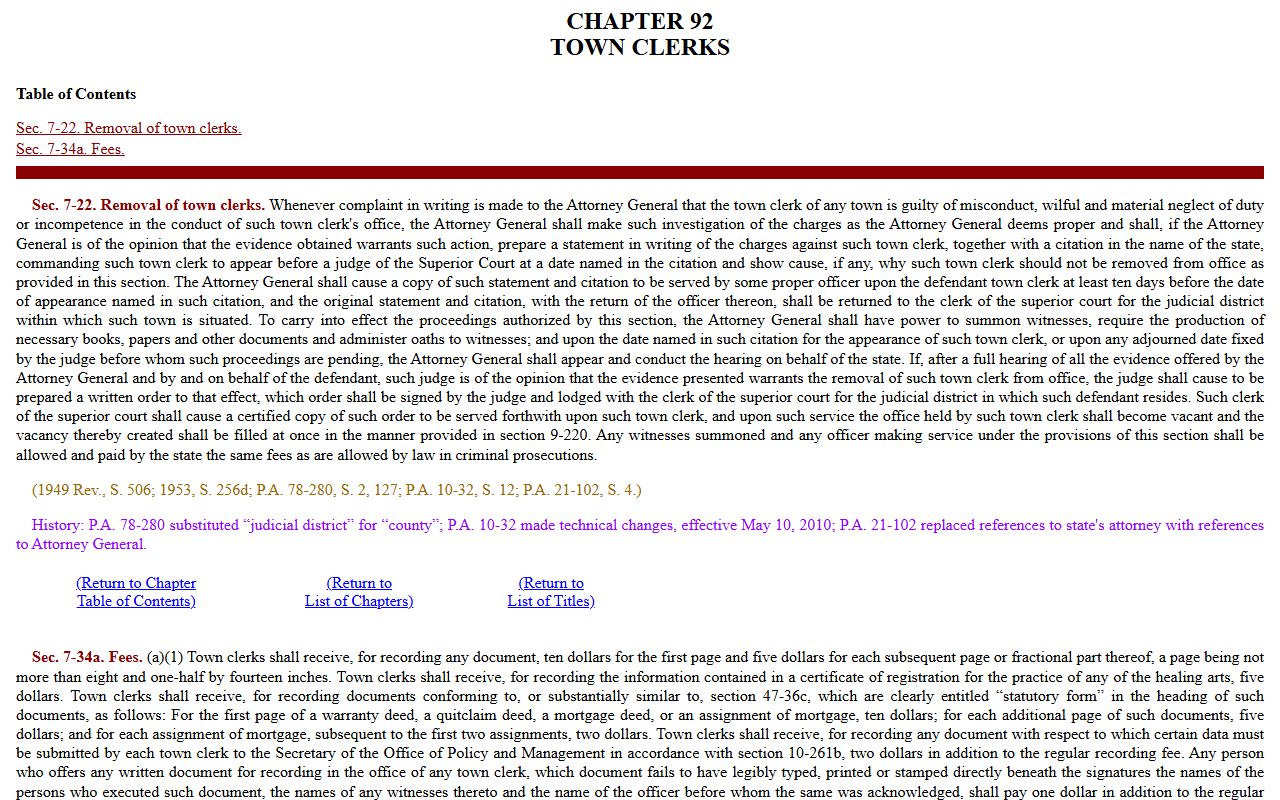
The image above displays Connecticut General Statutes Chapter 92, which covers town clerk duties and fees. Section 7-34a lists the recording fees that apply in Hartford and every other Connecticut town. These statutes ensure that all towns follow the same rules for accepting and recording land documents.
Conveyance Tax in Hartford
When property changes hands in Hartford, both state and local conveyance taxes apply. The state rate is 0.75% on the first $800,000 of a residential sale and 1.25% on the amount over $800,000. Non-residential property is taxed at 1.25% on the full sale price. Hartford also imposes a local conveyance tax. The local rate varies by municipality, but it is typically 0.25% to 0.5%. Check with the town clerk for the current local rate.
You report these taxes using Form OP-236, the Connecticut Real Estate Conveyance Tax Return. This form must be filed electronically through the Department of Revenue Services. The town clerk forwards a copy to the state within 10 days of recording. If your transaction involves more than two grantors, attach Schedule A. Multiple grantees or an entity grantee require Schedule B. Some transfers are exempt from conveyance tax, including gifts between family members and certain trust transfers.
E-Recording in Hartford
Hartford accepts electronic recordings through four approved vendors. Simplifile is one of the most widely used. You set up an account, upload your document, and pay the recording fee plus a small vendor fee. The system submits the document to the Hartford Town and City Clerk. The clerk reviews it and either records it or sends it back with a rejection notice. If recorded, you receive a digital copy with the official stamp and book-page reference.

The image above shows Simplifile, an e-recording vendor approved by Connecticut towns. E-recording saves time and money. You do not need to travel to the town clerk or wait in line. Other approved vendors include Corporation Service Company (CSC), eRecording Partners Network (ePN), and Indecomm. Each vendor works the same way. You upload the document, pay the fee, and receive a recorded copy electronically.
E-recording works for most land documents, including deeds, mortgages, releases, and assignments. Some transactions that require Form OP-236 may need to be filed in person. Check with your vendor or the clerk before submitting a conveyance electronically. Maps and subdivision plans may also require in-person filing. The Hartford Town and City Clerk can tell you which documents are eligible for e-recording and which must be submitted on paper.
Types of Recorded Documents
The Hartford Town and City Clerk records all documents that affect title to real estate. This includes warranty deeds, which provide full protection to the buyer, and quitclaim deeds, which transfer only the interest the grantor has. Mortgages are recorded when you borrow money to buy a house. When the loan is paid off, a release or discharge of mortgage is filed. Liens from contractors, tax authorities, and judgment creditors are also recorded. These liens attach to the property and must be satisfied before you can sell.
Other documents include easements, which grant rights to use land for specific purposes like utilities or access roads. Affidavits of title clarify ownership when there is a name change or an error in a prior deed. Condominium documents, including master deeds and association bylaws, are filed when a new condo development is created. Maps and subdivision plans show how land is divided into lots. All of these records are public. Anyone can search them and request copies.
Marketable Title in Connecticut
Connecticut law requires title searches to go back 40 years. This rule is part of the Marketable Record Title Act, found in CGS Title 47. If you can show an unbroken chain of ownership for 40 years, you have marketable title. The root of title must be a document recorded at least 40 years ago. Claims or defects that arose before the root of title are extinguished unless they were re-recorded or fall under an exception.
This law simplifies title searches. Instead of going back to the original land grant, you only need to check 40 years of records. Hartford land records go back much further, but for most transactions, a 40-year search is enough. Title companies and attorneys use this law to determine if a property has clear title. Certain interests, like easements and mineral rights, may survive even if they are older than 40 years.
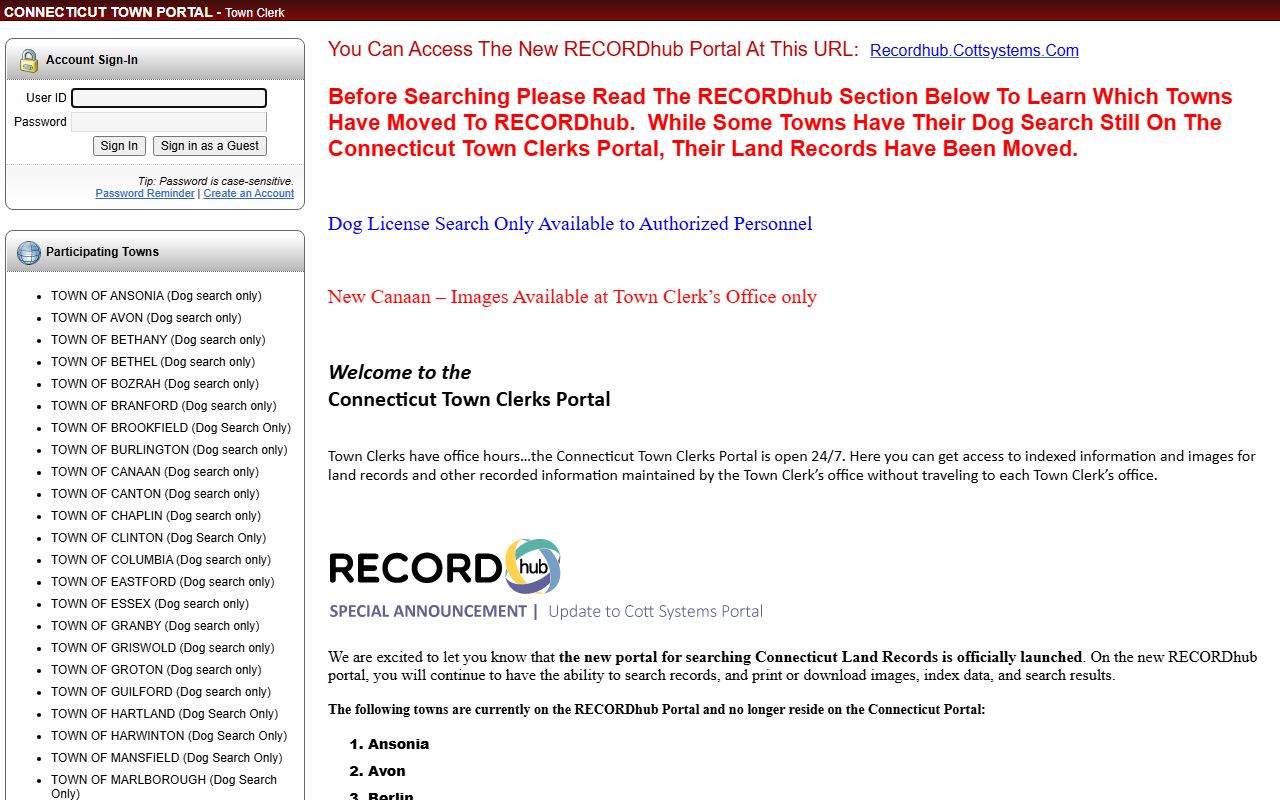
The Connecticut Town Clerks Portal serves more than 70 towns, including Hartford. This portal is open 24 hours a day and lets you search land record indexes and view document images. The image above shows the portal homepage. You select the town you want to search, then enter a name, date, or document type. The system displays results within seconds.
Legal Resources in Hartford
If you need legal advice about deed records, hire an attorney. The town clerk cannot give legal advice or tell you which type of deed to use. An attorney can prepare deeds, review title, and handle complex transactions. The Connecticut Secretary of the State provides business services and notary information, but does not offer legal referrals. The Connecticut Bar Association may help you find a real estate attorney in Hartford.
Legal aid organizations serve low-income residents who cannot afford private attorneys. Statewide Legal Services of Connecticut offers help with housing issues, which sometimes involve deed questions. Their services are free for those who qualify. You can find contact information on the Connecticut Judicial Branch website. The judicial branch is headquartered in Hartford and provides self-help resources and court forms.
Nearby Cities and Towns
Hartford is surrounded by other Hartford County towns that maintain their own land records. West Hartford is directly west and uses RecordHub for online access. East Hartford is across the Connecticut River and has its own town clerk. Manchester is to the east. Newington, Wethersfield, and Windsor also border Hartford. Each town has its own clerk, its own online system, and its own office hours.
When researching property in the Hartford area, make sure you know which town the land is in. Addresses can be misleading, especially near town borders. Check the property tax bill or ask the seller to confirm the town name. Recording a deed in the wrong town can delay closing and create title problems that are expensive to fix.