
Litchfield County Land Records
Litchfield County deed records are maintained by Town Clerks in each of the 26 municipalities that make up this northwestern Connecticut county. There is no county recorder or central filing office. Each town has its own land record books dating back to colonial times in many cases. Some Litchfield towns have records from the early 1700s. These historical documents are kept in fireproof vaults and newer records are digitized for online access. The county has about 180,000 residents spread across rural towns and a few small cities. Litchfield is the county seat but it is a small town. Most land transactions involve single-family homes, farms, woodlots, and recreational properties. The area is known for its scenic landscapes, historic villages, and preservation-minded communities. To search for a deed, you must know the town where the property is located and contact the town clerk in that municipality.
Litchfield County Quick Facts
How Land Records Work in Litchfield County
Connecticut abolished county government functions long ago. Land recording happens at the town level only. This means Litchfield County has no central records office. You cannot go to a county building and search all deeds in the county. Instead, you visit or contact the Town Clerk in the specific town where the land sits. Each clerk maintains a separate set of records. The 26 towns operate independently. Some have online databases. Others require in-person visits or mail requests.
This decentralized system reflects Connecticut's strong tradition of local control. Towns guard their autonomy. Each sets its own hours, fees for copies, and level of public access. State law governs recording requirements and base fees, but execution varies. Smaller towns may have limited hours or require appointments. Larger towns have dedicated land records staff and public access computers. If you are searching multiple towns, plan ahead. Call to confirm hours and availability. Some offices close for lunch or limit access to the vault where older records are stored.

The Town of Litchfield offers a good example of how the system works. The Town Clerk office at 74 West Street maintains records dating to the early 1700s. Online access is available through US Land Records. You can search grantor and grantee indexes for free back to May 24, 1979. Viewing documents is free but printing costs $2 per page. In-house copies are $1 per page. Certification adds $2. This pattern is common across Litchfield County towns. Online access may be limited to indexes or recent years, while complete records require a visit or paid subscription.
Recording Fees and Taxes
Recording fees in Connecticut are set by state statute. The current rate is $70 for the first page of any document and $5 for each additional page. This applies to deeds, mortgages, liens, easements, and other instruments. Nominee documents like MERS assignments have a flat $160 fee. Other MERS documents are $160 for the first page and $5 per additional page. These fees were increased on July 1, 2025 by Public Act 25-168. Check with the Town Clerk if you are unsure about fees for a specific document type.
Additional surcharges apply in some cases. If the deed involves a sale over $2,000, add $2 for the conveyance tax processing fee. If the grantee's address is missing, add $5. If names are not printed under signatures, add $1. Maps cost $20 to file. Subdivision maps with three or more parcels cost $30. These are statewide requirements found in Connecticut General Statutes Section 7-34a.
Conveyance taxes are separate from recording fees. The state tax is 0.75% on residential property up to $800,000 and 1.25% on the amount above $800,000. Non-residential property is taxed at 1.25%. Unimproved land is 0.75%. Each Litchfield County town also levies a municipal conveyance tax. The rate varies but is typically 0.25% to 0.50%. Litchfield town, for example, charges its own local rate. You must submit Form OP-236 with the deed to calculate and pay these taxes. The Town Clerk forwards the state portion to the Department of Revenue Services.
Document Requirements
All deeds and other recordable instruments must meet certain standards. The document must be in writing and signed by the grantor. It must be acknowledged before a notary public. Two witnesses are required. The notary can serve as one witness. All signatures must have the person's name printed or typed beneath them. The grantee's current mailing address must appear somewhere on the deed. Use black ink and a minimum 10-point font. Paper must be white, 8.5 by 11 inches or 8.5 by 14 inches. Leave margins for the recording stamp.
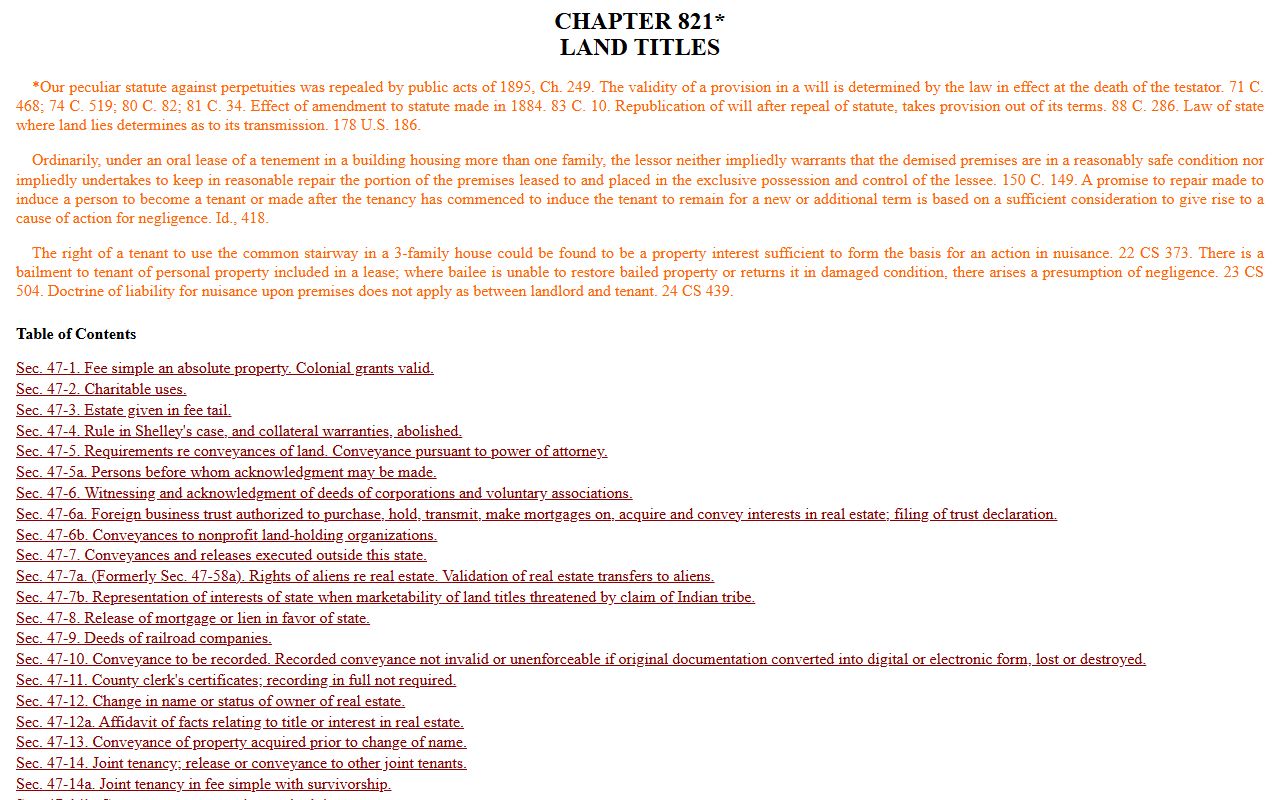
These rules come from Connecticut General Statutes Title 47, which governs land and land titles. Section 47-10 is the core provision. It states that no conveyance is effective to hold land against any other person except the grantor and his heirs unless it is recorded in the town where the land lies. Recording provides notice and establishes priority. An unrecorded deed is valid between the parties but does not protect against later purchasers or creditors.
Connecticut uses a race-notice recording system. The first to record wins, as long as they had no actual notice of an earlier unrecorded interest. This makes prompt recording critical. Delays can cause problems. If someone else records first, they may gain priority even if your deed is older. Title searches in Connecticut typically go back 40 years under the Marketable Record Title Act. This law, found in CGS Sections 47-33b through 47-33l, creates marketable title after an unbroken 40-year chain and extinguishes older defects and claims.
Online Access to Litchfield County Records
Many Litchfield County towns offer online land records access. The most common platform is US Land Records, operated by Cott Systems. You select the town, then search by grantor, grantee, date range, or book and page. Indexes are usually free. Viewing and printing documents may require a subscription or per-page fee. Subscription costs vary but are typically $30 for a month or $100 to $130 for a year. Some towns use RecordHub, another Cott product. A few are on the Connecticut Town Clerks Portal, a statewide system.
Not all towns have extensive online records. Small towns may only have recent indexes online. Older records, especially those before 1980, often exist only in paper form. Maps and surveys are rarely digitized. Very old documents may be handwritten in script that is hard to read. If you need to view original records or certified copies, you must contact the Town Clerk. Certified copies bear the town seal and clerk's signature. They are required for closings and legal proceedings. The cost is $1 per page plus a $2 certification fee per document.
Some Litchfield County towns have completed backfile scanning projects, digitizing decades of older records. Others have not. Check with each town to see what is available online. If the property changed hands before online records begin, you may need to visit the office. The clerk can assist with locating the right book and page. Clerks cannot provide legal advice or interpret documents, but they can help you navigate the filing system and locate records.
Major Towns in Litchfield County
Torrington is the largest city in Litchfield County with about 35,700 people. The Town Clerk office at 140 Main Street handles all land records. Torrington was a major industrial center in the 19th and early 20th centuries. Brass mills and factories drove growth. Many old deeds reference mill privileges, water rights, and worker housing. The city has a mix of urban and suburban properties. Title work here can be complex due to subdivisions, easements, and industrial history.
New Milford is the second-largest town with about 28,700 residents. The Town Clerk office at 10 Main Street maintains land records. New Milford is a growing community with a mix of old village center, suburban neighborhoods, and rural areas. The town spans a large geographic area along the Housatonic River. Properties range from historic homes in the village to large rural parcels. Online access is available through RecordHub. New Milford has seen significant development in recent decades, so many newer subdivisions have been recorded.
Other towns in Litchfield County include Barkhamsted, Bethlehem, Bridgewater, Canaan, Colebrook, Cornwall, Goshen, Harwinton, Kent, Litchfield, Morris, New Hartford, Norfolk, North Canaan, Plymouth, Roxbury, Salisbury, Sharon, Thomaston, Warren, Washington, Watertown, Winchester, and Woodbury. Each maintains its own land records. Population ranges from under 1,000 to several thousand. Rural character predominates. Large lot zoning, conservation easements, and historic districts are common. Some towns have lakes and recreational properties. Others are primarily agricultural or wooded.

E-Recording Services
Most Litchfield County towns accept electronic recording through approved vendors. This allows you to submit documents online without visiting the Town Clerk office. The four approved statewide vendors are Simplifile, Corporation Service Company (CSC), eRecording Partners Network (ePN), and Indecomm Global Services. You create an account with one or more vendors, upload your document as a PDF, pay the recording fee by credit card, and submit. The Town Clerk reviews and records the document, then sends back the recorded version with the book and page or document number.
E-recording has several advantages. You can submit documents 24/7 from anywhere. Processing is fast, usually within one business day. There is no need to mail or deliver paper. Errors are easier to fix because you can resubmit without reprinting. However, not all document types are eligible. Some clerks do not accept Form OP-236 transactions through e-recording. Check with the specific town before submitting. E-recording fees are the same as paper fees, but vendors may charge a small transaction fee of a few dollars.
To start using e-recording, contact the Town Clerk to get a customer ID. Then register with a vendor. Simplifile is at (800) 460-5657. CSC is at (866) 652-0111. ePN is at (888) 325-3365. Indecomm is at (651) 766-2350. If you are an attorney, title company, or lender who records frequently, e-recording saves time and reduces trips to town offices. For one-time users, paper recording may be simpler. Bring your document to the Town Clerk, pay the fee, and get it recorded on the spot.
Historical Records and Research
Litchfield County has some of the oldest land records in Connecticut. The town of Litchfield, for example, has records dating to the early 1700s. These early documents are written by hand in script. Ink has faded. Paper is brittle. Some pages are damaged or illegible. The Town Clerk keeps these records in a vault and restricts handling to preserve them. Researchers can view them under supervision. Photocopying old documents may not be allowed. Digital photography might be permitted with permission.
Early deeds often use old measurements like rods and chains. Descriptions reference landmarks that no longer exist. Trees, stones, roads, and streams mentioned in 18th-century deeds may be gone. Property lines have shifted. Boundary disputes are common when relying on very old descriptions. Professional surveyors use historical records along with modern surveys to reconstruct property lines. Title attorneys trace chains of title through successive deeds. The 40-year Marketable Record Title Act helps by cutting off claims older than 40 years in most cases.
Some Litchfield County towns have digital scans of older records. Others do not. If you are researching family history, historic properties, or long chains of title, contact the Town Clerk to ask about access. Some clerks are more accommodating than others. Genealogists and historians use land records to trace family ownership, locate homesteads, and understand settlement patterns. Many early families received land grants from the colonial government. These grants are the root of title for large portions of Litchfield County.
Cities in Litchfield County
Two cities in Litchfield County have populations over 25,000 and their own pages on this site. Torrington is the largest with about 35,700 people. New Milford has about 28,700 residents. Both maintain land records at their Town Clerk offices. Other towns are smaller and do not have separate pages. All land records are still available through the Town Clerk in each municipality.
Nearby Counties
Litchfield County borders several other counties. To the east is Hartford County, the most populous county in Connecticut. To the south are Fairfield County and New Haven County. Each follows the same town-based recording system. If property is near a county line, verify the town to avoid searching the wrong records. County boundaries do not always align with natural features. Some towns span multiple counties, though this is rare in Litchfield County.