
Tolland County Deed Records
Tolland County land records are maintained by individual Town Clerks in each of the 13 towns that form this northeastern Connecticut county. Connecticut has no county-level recording system. Each town keeps its own set of deeds, mortgages, liens, maps, and other instruments affecting real property. The county has roughly 150,000 people. Tolland is the county seat but it is a small town of about 15,000. Larger towns include Vernon and Mansfield. Most communities are suburban or rural with a mix of residential properties, farms, and commercial development. The University of Connecticut is located in Mansfield and Storrs. Online access to land records varies by town. Some have digitized records back to the 1940s or earlier. Others have limited online access. To find a deed, you must know which town the property is in and contact that Town Clerk directly or search their available databases.
Tolland County Quick Facts
Town-Based Recording in Tolland County
Land records in Connecticut are kept at the town level. There is no county recorder or central office. Each town has a Town Clerk who serves as the official recorder of deeds. State law requires that all instruments affecting land be recorded in the town where the property is located. Recording in the wrong town provides no legal notice. Tolland County has 13 towns. Each operates independently. They share the same state statutes and fee schedules but hours, online systems, and local practices vary.
The 13 towns are Andover, Bolton, Columbia, Coventry, Ellington, Hebron, Mansfield, Somers, Stafford, Tolland, Union, Vernon, and Willington. Some are small rural communities. Others are larger suburban towns. Vernon has about 31,000 people. Mansfield has about 28,000, many of whom are students at UConn. The Town of Tolland has about 15,000. Smaller towns like Union have fewer than 1,000 residents. Each town has a Town Clerk office that maintains land records.

The Town of Tolland provides a good example. The Town Clerk office at 21 Tolland Green maintains land records dating back to 1715. Online access is available through US Land Records. You can search grantor and grantee indexes from February 25, 1942 to present. Viewing and searching are free. Printing costs $2 per page. In-house copies are $1 per page. Certification adds $2. Historical records from 1715 to 1942 are in the office but not online. This pattern is common across Tolland County. Online systems cover recent decades. Older records require office visits.
How to Record Documents
To record a deed or other document in Tolland County, you go to the Town Clerk office in the town where the land is located. Bring the original document. The clerk will review it to make sure it meets state requirements. If it is acceptable, the clerk stamps it with the recording date and time, assigns a book and page or document number, and adds it to the town's land records. You get the original back with the recording information on it. The document is now part of the permanent public record.
You can also record by mail. Send the original document, a check for the recording fee, and a self-addressed stamped envelope. The clerk will record it and return it. Processing takes several days. E-recording is faster. Most Tolland County towns accept electronic recording through approved vendors like Simplifile, CSC, ePN, or Indecomm. You upload a PDF, pay online, and get the recorded document back electronically within one business day in most cases.
Recording fees are set by Connecticut statute. The current rate is $70 for the first page and $5 for each additional page. This applies to deeds, mortgages, releases, easements, and similar documents. Nominee documents like MERS assignments cost $160 flat fee. Other MERS documents are $160 for the first page and $5 per additional page. If the deed involves a sale over $2,000, you must submit Form OP-236 for conveyance tax. The state conveyance tax is 0.75% for residential property up to $800,000 and 1.25% for amounts over $800,000 or for non-residential property. Towns also charge a municipal conveyance tax.
Legal Requirements for Deeds
Connecticut law sets strict requirements for recordable documents. A deed must be in writing and signed by the grantor. It must be acknowledged before a notary public. Two witnesses are required. The notary can be one witness. All signatures must have names printed or typed beneath them. The grantee's current mailing address must appear on the deed. Use black ink and a minimum 10-point font. Paper must be white, 8.5 by 11 inches or 8.5 by 14 inches. Leave margins for the clerk's recording stamp.
These requirements come from Connecticut General Statutes Title 47, which governs land titles. Section 47-10 is the key statute. It says no conveyance is effective to hold land against any other person except the grantor and his heirs unless it is recorded in the town where the land lies. Recording provides notice to the public and establishes priority. An unrecorded deed is valid between the parties but does not protect against later buyers or creditors.
Connecticut uses a race-notice recording system. The first person to record wins, as long as they did not have actual notice of an earlier unrecorded interest. This makes prompt recording critical. Delays can cause serious problems. If someone else records first, they may gain priority even if your deed is older. Title searches in Connecticut typically go back 40 years under the Marketable Record Title Act, found in CGS Sections 47-33b through 47-33l. This law creates marketable title after 40 years and extinguishes older defects and claims.
Online Access to Records
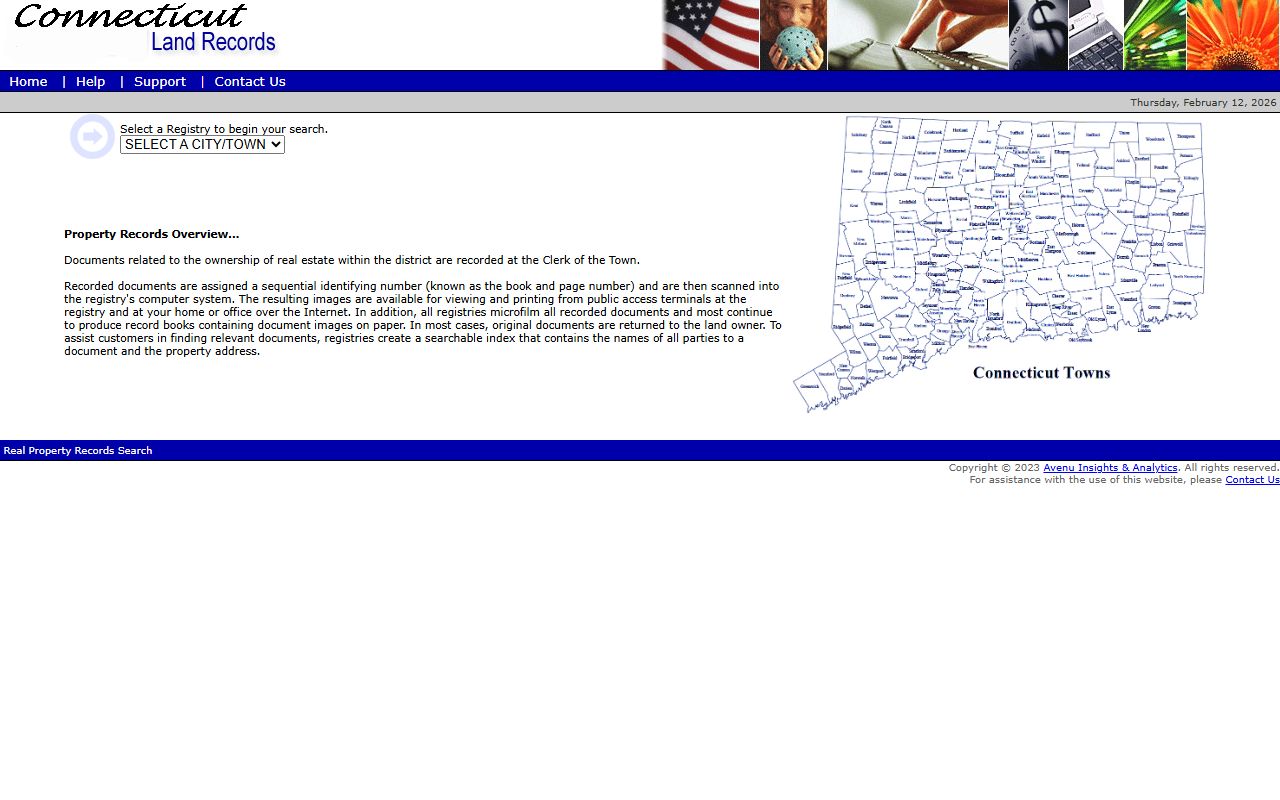
Many Tolland County towns offer online land records access. The most common platform is US Land Records, operated by Cott Systems. You select the town, then search by grantor, grantee, date, or book and page. Viewing indexes is usually free. Printing or downloading documents may require a subscription or per-page fee. Subscription costs vary but are typically $30 for one month or $100 to $130 for one year. Some towns use RecordHub or the Connecticut Town Clerks Portal.
Not all towns have complete online records. Smaller towns may only have indexes online or just recent years. Older documents, especially those before 1970, often exist only in paper form. Maps and plans are rarely digitized. Very old deeds may be handwritten in script that is hard to read. If you need original records or certified copies, contact the Town Clerk. Certified copies have the town seal and clerk's signature. They are required for closings and legal proceedings. The cost is $1 per page plus $2 for certification.
Some towns have completed backfile projects to digitize older records. The Town of Tolland has online indexes back to 1942. Vernon and Mansfield have similar coverage. Smaller towns may only have records from the 1980s or 1990s online. Check with each town to see what is available. If the property changed hands decades ago, you may need to visit the office or hire a title searcher to locate the records.
Conveyance Taxes and Additional Fees
Conveyance taxes are based on the sale price or consideration. Connecticut has state and municipal conveyance taxes. The state rate for residential property is 0.75% on the first $800,000 and 1.25% on amounts above $800,000. Commercial property is 1.25% on the full amount. Unimproved land is 0.75%. Each town also imposes a municipal conveyance tax. Rates vary but are typically 0.25% to 0.50%. You pay both taxes when recording the deed.
Form OP-236 must accompany every deed with consideration over $2,000. This is the Connecticut Real Estate Conveyance Tax Return. It has two copies. One stays with the Town Clerk. One goes to the Department of Revenue Services. The Town Clerk forwards the DRS copy within 10 days. You pay the state and municipal taxes at recording. The Town Clerk collects the municipal portion. DRS gets the state portion.
Additional fees apply in some cases. If the grantee's address is missing, add $5. If names are not printed under signatures, add $1. Maps cost $20 to file. Subdivision maps with three or more parcels cost $30. These surcharges are set by CGS Section 7-34a. They are the same in all Connecticut towns. Copy fees are $1 per page. Certification is $2 per document.
E-Recording and Modern Services
Most Tolland County towns accept e-recording. This lets you submit documents online without going to the Town Clerk office. Four vendors are approved statewide: Simplifile, Corporation Service Company (CSC), eRecording Partners Network (ePN), and Indecomm Global Services. You create an account, upload your document as a PDF, pay the fee by credit card, and submit. The Town Clerk reviews and records it, then sends back the recorded version electronically.
E-recording is fast. Processing is usually within one business day. You can submit 24/7. There is no need to travel or mail documents. Errors can be fixed and resubmitted quickly. However, not all document types are eligible. Some clerks do not accept Form OP-236 transactions via e-recording. Check with the town before submitting. E-recording fees are the same as paper fees, but vendors may charge a small transaction fee of a few dollars.
To start e-recording, contact the Town Clerk to get a customer ID. Then register with a vendor. Simplifile is at (800) 460-5657. CSC is at (866) 652-0111. ePN is at (888) 325-3365. Indecomm is at (651) 766-2350. If you are an attorney, title company, or lender, e-recording saves time. For one-time users, paper or mail recording may be simpler.

Vernon and Mansfield
Two towns in Tolland County have populations over 25,000. Vernon has about 31,000 residents. The Town Clerk office at 725 Hartford Turnpike handles land records. Vernon is a suburban town with a mix of residential neighborhoods and commercial areas. It includes the village of Rockville, a former mill town. Land records reflect this industrial history. Old deeds may reference mill privileges, water rights, and factory sites.
Mansfield has about 28,000 residents, including many UConn students. The Town Clerk office at 4 South Eagleville Road maintains land records. The University of Connecticut owns large parcels of land in Mansfield. Student housing, academic buildings, and agricultural research facilities cover much of the town. Town land records include residential properties, farms, and commercial sites. University property may be recorded differently or held under state ownership.
Other Towns in Tolland County
The remaining 11 towns in Tolland County are smaller. They include Andover, Bolton, Columbia, Coventry, Ellington, Hebron, Somers, Stafford, Tolland, Union, and Willington. Populations range from under 1,000 in Union to about 15,000 in Tolland and Ellington. Most are residential or agricultural. Some have small village centers. Others are spread out. Each has a Town Clerk office that maintains land records. Online access varies. Contact each town for information on hours and services.
Nearby Counties
Tolland County borders several other Connecticut counties. To the west is Hartford County, the most populous county in the state. To the south is Middlesex County. To the east is Windham County. Each follows the same town-based recording system. If property is near a county line, make sure you know which town it is in before searching records. County boundaries do not always align with natural features or roads.