
Fairfield Land Records Search
Fairfield maintains all land records through the Town Clerk at 611 Old Post Road. This office files deeds, mortgages, liens, and other property documents for the entire town. When you buy or sell real estate in Fairfield, the transaction must be recorded here. The clerk keeps an index of all filings going back to 1929 online, with earlier records available in the office. You can search these records to verify ownership, check for liens, or research property history. Many records are now accessible online through the SearchIQS platform. This allows you to search from home at any time. The clerk also stores maps and surveys that show property boundaries. Documents must meet specific standards to be accepted. The last land recording is accepted at 4:00 PM each day.
Fairfield Quick Facts
Online Access via SearchIQS
Fairfield uses the SearchIQS platform to provide online access to land records. You can search the database at searchiqs.com/ctfai. The index goes back to 1929. Earlier records are available in person at the clerk's office. You can search by name, date, or document type. The system shows basic information about each filing. To view full document images, you may need to subscribe.
The online system is updated regularly as new documents are recorded. This means you can find recent sales or mortgage filings within a short time. If you are doing a title search, this is a quick way to check for liens or other encumbrances. For older records, the index may point you to the right book and page. If you cannot find what you need online, visit the Town Clerk's office in person.
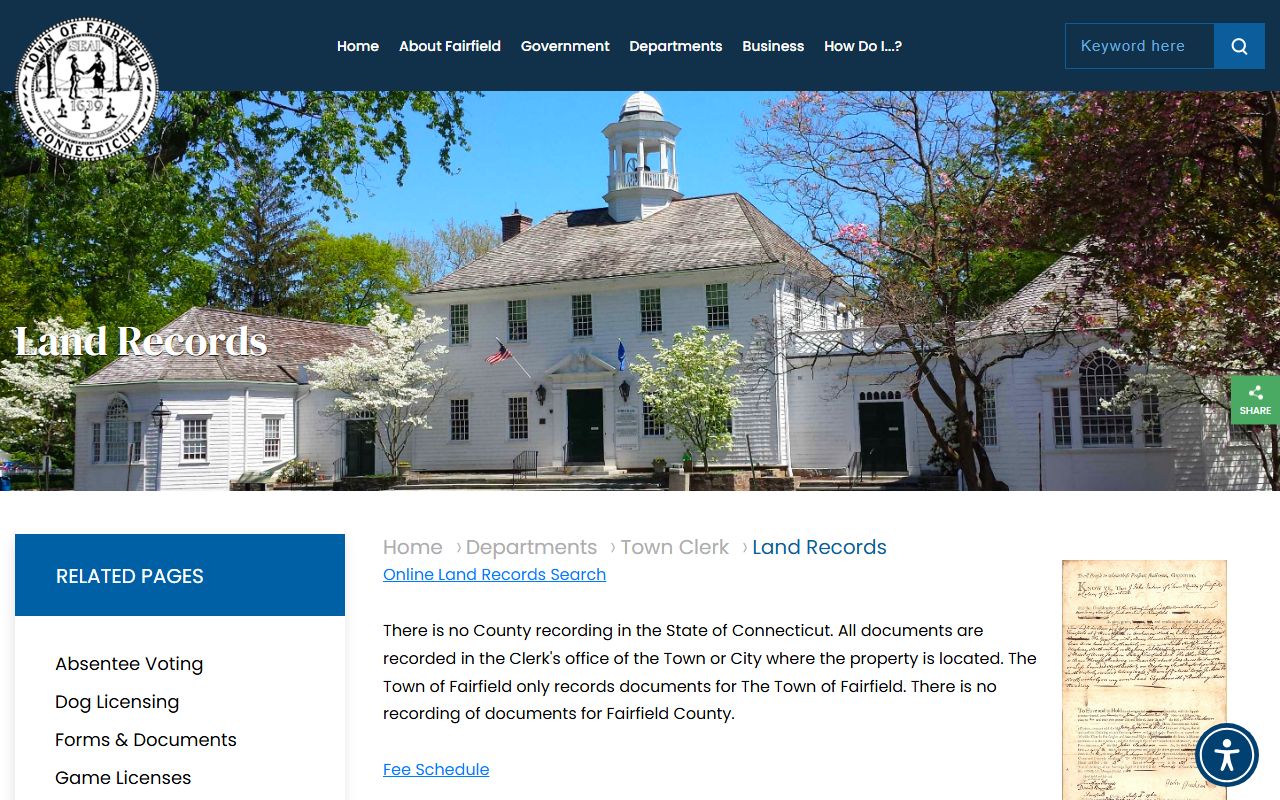
Visit the Fairfield town website for more information about accessing land records. The site has links to the online portal and instructions for searching. If you have questions, call the Town Clerk's office at (203) 256-3090. Staff can help you navigate the system, but they cannot provide legal advice.
Recording Fees and Requirements
Fairfield follows the state fee schedule for recording land documents. As of July 1, 2025, the fee is $70 for the first page and $5 for each additional page. If the document involves a MERS nominee, the first page costs $160. This fee applies to assignments and releases as well. Copies cost $1 per page, and certification adds $2 per document. Maps cost $20 to file, or $30 for subdivision maps with three or more parcels.
Before you record a deed, make sure it meets all legal requirements. The document must be signed by the grantor and notarized. Two witnesses should also sign. Names must be typed or printed beneath each signature. The grantee's current mailing address must appear on the deed. If it is missing, you pay an extra $5. Use black ink and white paper in standard size. These rules are set by Connecticut General Statutes Title 47.
When property is sold, the deed must be accompanied by Form OP-236. This form calculates the state and local conveyance tax. The clerk collects the tax and forwards it to the Department of Revenue Services. Make sure the form is filled out correctly. If there are multiple grantors or grantees, attach the required schedules. The clerk cannot record the deed without the tax form.
Types of Documents Recorded
The Town Clerk records several types of land documents. Warranty deeds are used for most property sales. The seller promises that the title is clear and will defend it if challenged. Quitclaim deeds transfer whatever interest the grantor has, with no guarantees. These are often used between family members or to clear up title issues. Mortgage deeds create a lien on the property to secure a loan. When the loan is paid off, a release of mortgage is recorded.
Liens can be filed by contractors, tax authorities, or through court judgments. A lien attaches to the property and must be paid before the property can be sold. Easements give someone the right to use part of the land, such as for a driveway or utility line. All of these documents are public records. Anyone can search them to learn about property ownership or debts.
E-Recording Services
Fairfield accepts electronic recording through several approved vendors. These include Simplifile, CSC, ePN, and Indecomm. E-recording lets you submit documents online without visiting the office. This is faster and more convenient, especially for attorneys and title companies. You must register with one of the approved vendors to use this service.
Once a document is submitted electronically, the clerk reviews it for completeness. If everything is in order, the document is recorded and stamped. The recorded copy is sent back to you electronically. This process usually happens the same day if submitted during business hours. E-recording is available for most types of land documents, including deeds, mortgages, and releases.
Conveyance Tax and Form OP-236
Connecticut law requires a conveyance tax on most property sales. The state rate for residential property is 0.75% on the first $800,000 and 1.25% on amounts above that. Non-residential property is taxed at 1.25% on the full amount. Fairfield also collects a local conveyance tax, the rate of which is set by town ordinance. These taxes are paid by the seller at closing.
Form OP-236 is used to calculate and report the tax. The form must be submitted in duplicate: one copy for the town and one for the state. The town clerk forwards the state's copy to the Department of Revenue Services within ten days. If there are multiple grantors, attach Schedule A. If there is more than one grantee or the grantee is a business, attach Schedule B. These forms are available on the DRS website.
Legal Framework for Land Records
Connecticut General Statutes Title 47 governs land records and conveyances. Section 47-10 states that no conveyance is valid against third parties unless it is recorded in the town where the land is located. This means recording your deed protects your ownership from later claims. The law also requires that deeds be signed, notarized, and witnessed. These formalities help prevent fraud.
The Marketable Record Title Act, found in CGS 47-33b through 47-33l, establishes that a 40-year chain of title is sufficient for marketable title. This law helps clear old defects and claims. If a property has an unbroken chain of title for 40 years, earlier issues are extinguished. This makes it easier to sell property without extensive title searches. The act applies to most types of land in Connecticut.
CGS Title 7 sets the duties and fees of town clerks. Section 7-34a lists the standard recording fees. It also allows for electronic recording if the town clerk chooses to accept it. The law imposes penalties for documents that do not meet formatting requirements. Always check your paperwork before filing to avoid extra fees or rejection.
Historical Records and Research
Fairfield has land records going back centuries. The online index starts in 1929, but earlier records exist in the office. Older documents are kept in bound volumes at the clerk's office. Some of these have been preserved carefully due to their age. If you are researching your home's history, start with the online index. It may point you to the right book and page. If the record predates 1929, visit the clerk's office during business hours.
Maps and surveys are also part of the land records system. These show property boundaries and can help settle disputes. Historical maps can show how the town developed over time. If you need a certified copy of an old deed or map, contact the clerk. They will print and certify it for a fee. Certified copies can be used in court or for title insurance purposes.
Property Fraud Prevention
Property fraud is a concern for homeowners. Criminals may file false deeds to steal ownership. To protect yourself, check your property records regularly. You can do this through the online portal or by visiting the clerk's office. If you see a document you did not authorize, contact the clerk and the police immediately. You may need an attorney to file a corrective deed or take court action.
Some towns offer fraud alert services that send emails when a document is recorded under your name. Check with the Fairfield Town Clerk to see if this service is available. Keep copies of all your property documents in a safe place. This makes it easier to prove ownership if a problem arises.
Nearby Towns and County Resources
Fairfield is part of Fairfield County. In Connecticut, there is no county-level recording of land records. Each town keeps its own files. Nearby towns include Bridgeport, Norwalk, and Westport. If you own property in multiple towns, you must record deeds in each one separately. Stamford and Greenwich also have land records offices with online access.
For statewide resources, visit the Connecticut Town Clerks Portal. Over 70 towns participate in this system, which allows you to search across multiple locations. You can also use US Land Records for multi-town searches. The Connecticut Secretary of the State provides information on notaries and business filings.
Contact Information
The Fairfield Town Clerk is located at 611 Old Post Road. For general questions, call (203) 256-3090. The office accepts land recordings until 4:00 PM each day. If you need to record a document, bring it in person or mail it with a check for the recording fee. E-recording is also available through approved vendors. The office is open during regular business hours on weekdays.
The clerk cannot give legal advice or prepare documents for you. If you need help drafting a deed, consult a real estate attorney. For questions about property taxes or assessments, contact the Tax Assessor's office. For zoning or building permits, contact the Planning Department.