
Search New London County Land Records
New London County deed records are not kept at a county level in Connecticut. Each of the 22 towns maintains its own land records at the Town Clerk office where the property is located. To find a deed, you need to know which town the property sits in. Records include warranty deeds, quitclaim deeds, mortgage documents, liens, and maps. Most towns offer online access through shared portals or individual systems. Some records date back to the early colonial period. New London County has about 266,000 residents spread across coastal and inland communities. The county seat is New London. Land records here follow Connecticut's decentralized model where no county recorder exists. You search at the town level, not the county level, contacting each town clerk directly or using their online systems.
New London County Quick Facts
New London County Recording System
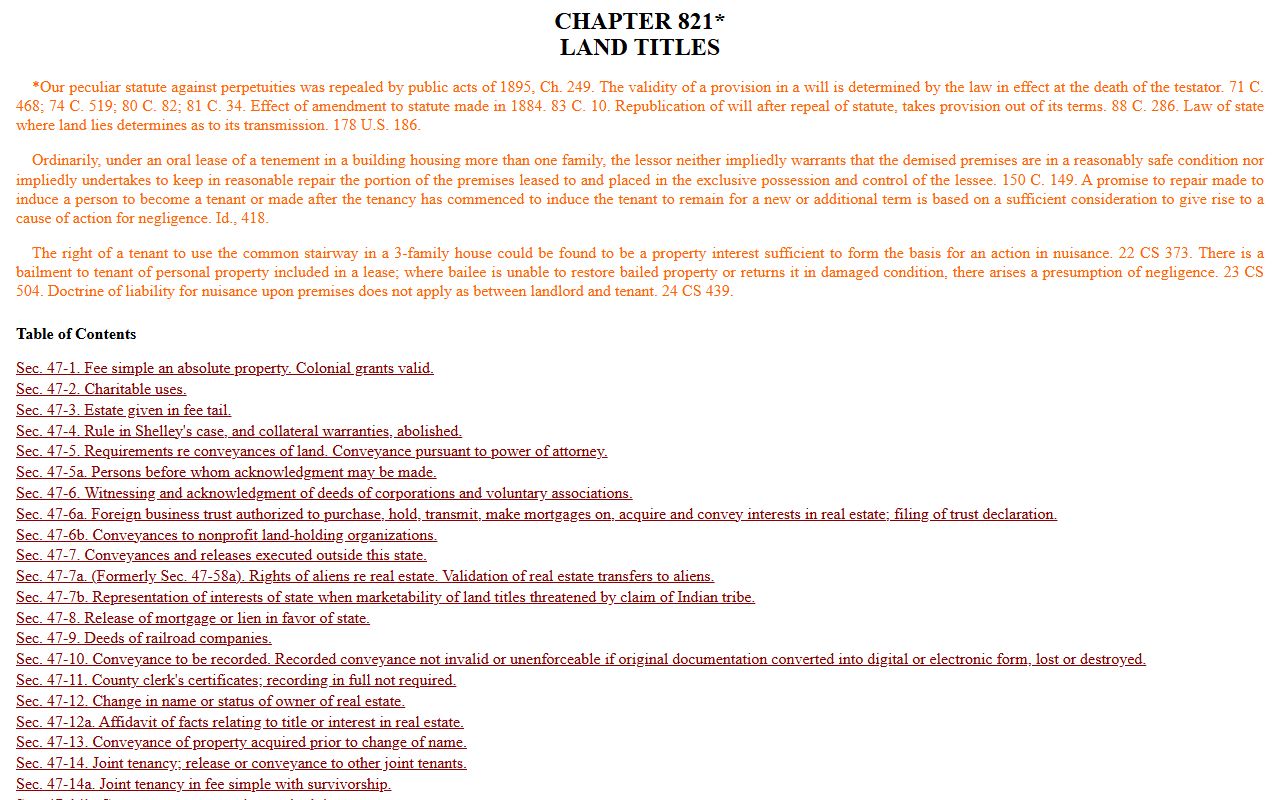
Connecticut does not have county recorders. Land records are filed with the Town Clerk in the municipality where the property is located. This is true across all of Connecticut, including New London County. Each town has its own land record books, indexes, and databases. The recording process is governed by Connecticut General Statutes Title 47, Chapter 821. A deed must be recorded to be effective against third parties, even if it is valid between grantor and grantee. Unrecorded deeds create title problems. Recording establishes priority and provides public notice.
New London County has 22 towns. These range from small rural communities to the cities of New London, Norwich, and Groton. The coastal location has shaped development patterns. Historic districts, maritime properties, and military installations add complexity to title work. Tribal lands and federal properties may not appear in town land records. Waterfront boundaries require special attention. Each town maintains permanent records going back decades or centuries. Early records are handwritten and stored in bound volumes. Modern records are digital but still filed in town offices.
To record a document in New London County, you deliver it to the Town Clerk where the land is located. Most towns accept walk-in recordings during business hours. Some have specific recording windows. E-recording is available through approved vendors like Simplifile, CSC, ePN, and Indecomm. The standard fee is $70 for the first page and $5 for each additional page, set by Connecticut statute. Nominee documents like MERS assignments cost $160. If the deed involves a sale over $2,000, you must submit Form OP-236 for conveyance tax. The state conveyance tax is 0.75% up to $800,000 for residential property and 1.25% above that amount or for commercial property. Towns also levy a municipal conveyance tax.
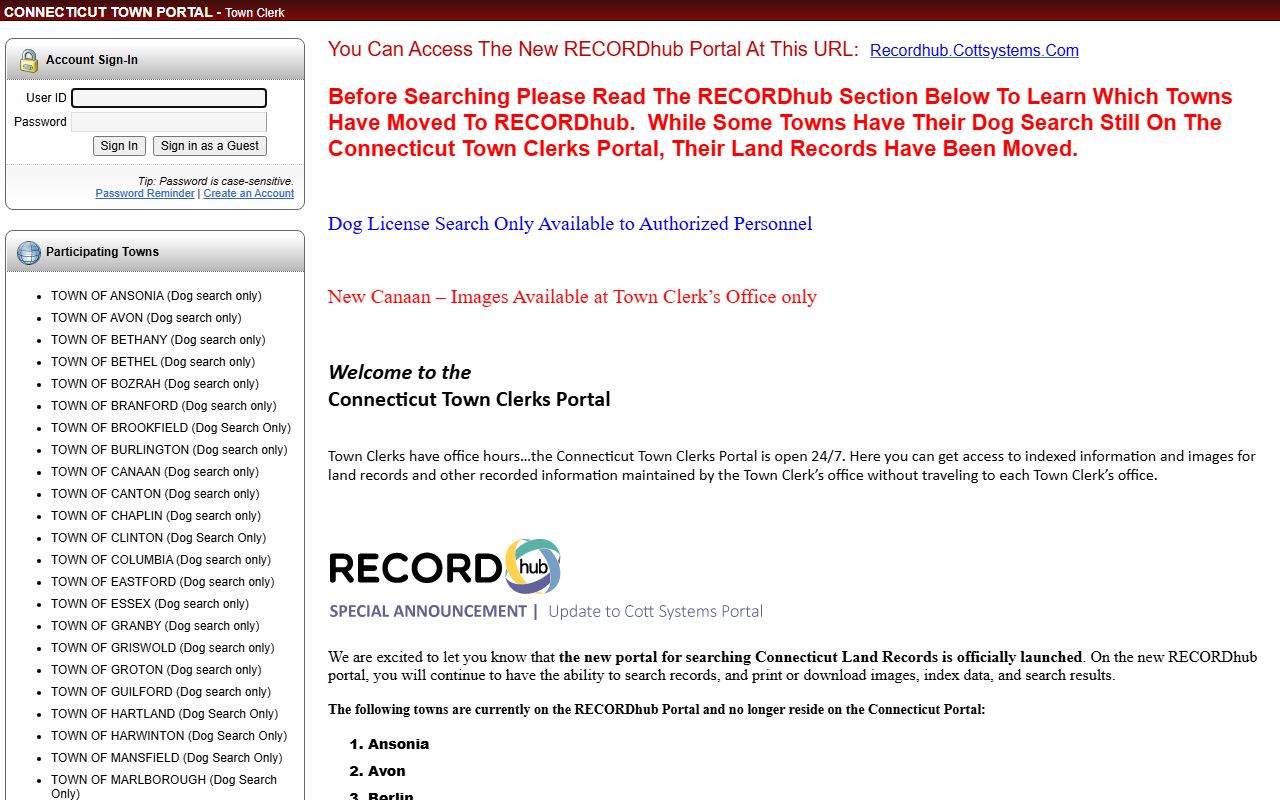
Many New London County towns participate in the Connecticut Town Clerks Portal, which provides 24/7 online access to land record indexes and images. This statewide portal lets you search by name, book and page, or parcel. Viewing indexes is usually free but printing or downloading images may require a subscription or per-page fee. Some towns use other systems like US Land Records, RecordHub, or IQS platforms. A few smaller towns may not have online access yet. You would need to visit the Town Clerk office in person or request copies by mail.
Major Towns in New London County
New London is the county seat and a city of about 28,000 people. The City Clerk office at 181 State Street handles land records. Office hours are Monday through Friday, 8:30 AM to 4:00 PM. Title searches are by appointment. New London has a deep harbor and significant maritime history. The U.S. Coast Guard Academy is located here. Naval Submarine Base New London is actually in Groton. Land records reflect this maritime and military influence. Properties near the waterfront or in historic districts may have complex title chains.
Norwich is the largest city in the county with nearly 40,000 residents. The Town Clerk office is at 100 Broadway. Norwich was a major industrial center in the 19th century. Mills, factories, and worker housing shaped development. Many old deeds reference water rights, dam easements, and mill privileges. The city spans both sides of the Thames River and includes several distinct neighborhoods. Title work here often requires reviewing older records to trace complex subdivision patterns and easements.
Groton includes both the town and the City of Groton. Combined population is about 39,000. The Town Clerk office at 45 Fort Hill Road handles land records. Groton is home to Naval Submarine Base New London and General Dynamics Electric Boat. Large portions of land are federal property and do not appear in town records. The Mashantucket Pequot and Eastern Pequot tribal nations also have land in the area under different jurisdictional rules. Waterfront properties, marina easements, and submarine cable rights-of-way are common title considerations.

Online Access to New London County Records
Most residents search land records online. The Connecticut Town Clerks Portal is the main statewide system. Over 70 Connecticut towns participate. You select the town, then search by grantor, grantee, document type, date range, or book and page. The portal shows indexed data and scanned images. Some towns have records going back to the 1940s or earlier online. Others only have recent years digitized. Check with each town to see how far back their online records go.
Another option is US Land Records, which covers multiple Connecticut towns. This is a subscription-based service operated by Cott Systems. You can search for free but printing or viewing images requires payment. Some towns use RecordHub or IQS platforms instead. A few maintain their own custom databases. If you are doing frequent research, consider subscribing to one or more services. Costs vary but are usually $30 to $130 per year per town or system.
Online access is convenient but has limits. Not all towns have complete historical records online. Very old deeds, especially those recorded before 1950, may only exist in paper form. Maps and plans are often not digitized. Some documents are illegible or poorly scanned. If you need certified copies for a real estate closing or legal proceeding, you must request them from the Town Clerk. Certified copies have the town seal and signature. They cost $1 per page plus a $2 certification fee per document.
Recording Fees and Conveyance Taxes
Connecticut recording fees are set by statute. As of July 1, 2025, the standard fee is $70 for the first page of any document and $5 for each additional page. This applies to deeds, mortgages, releases, assignments, easements, and other instruments affecting title. If the document is a MERS nominee assignment or release, the fee is a flat $160 with no per-page charge. Other MERS documents are $160 for the first page and $5 for additional pages.
There are also surcharges. If you record a deed with consideration over $2,000, add $2 for the conveyance tax processing fee. If the grantee's mailing address is missing from the deed, add $5. If names are not printed beneath signatures, add $1. These surcharges are statewide. Maps cost $20 to file. Subdivision maps with three or more parcels cost $30. Copy fees are $1 per page in the office. Certification is $2 per document.
Conveyance taxes are separate from recording fees. The state conveyance tax is calculated on the consideration amount. For residential property up to $800,000, the rate is 0.75%. For the portion above $800,000, the rate is 1.25%. Non-residential property is taxed at 1.25% on the full amount. Unimproved land is taxed at 0.75%. Towns also impose a municipal conveyance tax. Rates vary by town but typically range from 0.25% to 0.50%. Form OP-236 must be submitted with the deed to calculate and pay these taxes. The Town Clerk forwards the state portion to the Department of Revenue Services within 10 days.
Document Requirements for Recording
Connecticut has specific requirements for deeds and other recordable documents. The document must be in writing, signed by the grantor, and acknowledged before a notary public. Two witnesses are required. The notary can be one of the witnesses. Names must be printed or typed beneath all signatures. The grantee's current mailing address must appear on the deed. Use black ink and a minimum 10-point font. Paper must be white, 8.5 by 11 inches or 8.5 by 14 inches. Margins must allow room for recording stamps.
These rules are found in Connecticut General Statutes Title 47. If a document does not meet the requirements, the Town Clerk may refuse to record it. Fixing errors takes time and can delay closings. Have an attorney prepare deeds and other complex documents. Town Clerks cannot provide legal advice or draft documents for you. They only record what is presented. Once recorded, the document is returned to you with a book and page or document number stamped on it. That number is the official citation for the record.
Connecticut follows a race-notice recording system. The first person to record a deed has priority, provided they did not have notice of an earlier unrecorded interest. This makes recording essential. Even if you hold a valid deed, someone who records first could take priority. Recording also starts the chain of title. Title searches in Connecticut typically go back 40 years under the Marketable Record Title Act, which is codified in CGS Sections 47-33b through 47-33l. This statute extinguishes old defects and claims if there is an unbroken 40-year chain.
E-Recording in New London County
Most New London County towns accept electronic recording. This lets you submit documents online without visiting the Town Clerk office. Four vendors are approved statewide: Simplifile, Corporation Service Company (CSC), eRecording Partners Network (ePN), and Indecomm Global Services. You register with one or more vendors, upload your document as a PDF, pay fees by credit card, and submit. The Town Clerk reviews and records the document electronically, then returns it with the recording information.
E-recording is faster and more convenient than paper recording. There is no travel required. You can submit documents after business hours. Processing is usually within one business day. However, not all document types are eligible. Some Town Clerks do not accept documents with Form OP-236 through e-recording. Check with the specific town before submitting. E-recording fees are the same as paper fees, but vendors may charge a transaction fee.
To start e-recording, contact the Town Clerk to obtain a customer ID. Then register with an approved vendor. Simplifile can be reached at (800) 460-5657. CSC is at (866) 652-0111. ePN is at (888) 325-3365. Indecomm is at (651) 766-2350. Some vendors also handle title searches and other services. If you record frequently, e-recording saves time and reduces errors from illegible handwriting or incomplete information.
Property Fraud Alerts
Some New London County towns offer property fraud alert services. You register your name and property information with the Town Clerk's database. If any document is recorded with your name as grantor or grantee, you receive an email alert. This helps detect fraudulent deeds or unauthorized mortgages. Property fraud has increased in recent years. Criminals forge deeds and transfer property without the owner's knowledge. Alert services provide an early warning.
Alerts are free in most towns. You sign up through the town's land records website. Some towns use third-party services like IQS Fraud Alert or similar systems. You can register multiple properties and names. Alerts are sent within 24 hours of recording. If you receive an alert for a document you did not authorize, contact the Town Clerk immediately. You may need to file a police report and work with an attorney to void the fraudulent document.
Cities and Towns in New London County
New London County has three cities over 25,000 population that have their own pages on this site. New London is the county seat with a population of about 28,000. Norwich is the largest city with nearly 40,000 residents. Groton has about 39,000 people and includes the town and city. Each maintains its own land records system. Smaller towns include Bozrah, Colchester, East Lyme, Franklin, Griswold, Lebanon, Ledyard, Lisbon, Lyme, Montville, North Stonington, Old Lyme, Preston, Salem, Sprague, Stonington, Voluntown, and Waterford. All have Town Clerk offices with land records.
Nearby Counties
New London County borders several other Connecticut counties. To the west is Middlesex County, which has 15 towns including Middletown. To the northwest is Tolland County with 13 towns. North of New London County is Windham County with 16 towns. Each county follows the same decentralized recording system. If property is near a county line, verify which town it is in before searching records. Town boundaries do not always follow county lines, and a few towns span multiple counties.